
Review · GREECE OLIVE OIL TOURS
Olicatessen Olive Oil Tasting in Thessaloniki
Greek olive oil is far more varied than the bottle on your restaurant table suggests. At Olicatessen, you taste six oils from different Greek regions and olive varieties, then learn how aroma, texture, and flavor reveal where and how each one was made.
I like the direct connection with small producers, and I like that this is held inside Modiano Market, right in the center of Thessaloniki. The session is private, so your questions get proper attention. The main consideration is price: at $40.52 per person for about an hour, it is best suited to food lovers who want more than a quick sample.
Key points
- Six oils, six different profiles: Compare regional and varietal differences side by side.
- A practical tasting lesson: Learn to assess aroma, texture, flavor, and other organoleptic qualities.
- Inside Modiano Market: The central location fits neatly into a day of exploring Thessaloniki.
- Producer stories matter: Olicatessen works directly with producers and explains the people behind the bottles.
- Private and personal: Only your group takes part, giving you room to ask questions.
- A Greek food pairing finishes the hour: The final bite is chosen to match the oils and complete the tasting.
Six Greek olive oils in one careful sitting
The heart of this experience is a guided comparison of six olive oils. You are not simply dipping bread into one bottle and being told it is good. You taste oils from different parts of Greece and made from different olive varieties, then consider how their character changes from one sample to the next.
That comparison is the useful part. A single oil can be hard to judge because you have nothing beside it. Six samples let you notice contrasts in aroma, texture, and flavor. One may seem more delicate, another more forceful. You may find grassy notes in one, a peppery finish in another, or a smoother feel in a third.
The session is also a good correction to the idea that all Greek olive oil tastes the same. Greece has many growing areas, local traditions, and olive varieties. This tasting gives you a short, organized way to sense those differences without needing to visit several producers across the country.
You will also discuss the organoleptic qualities of each oil. That is the formal language used to assess sensory traits. In plain terms, you learn what to notice with your nose, tongue, and palate, rather than judging only by color or the shape of a bottle.
More Olive Oil Tours around Greece:
- Crete: Quad Safari, Olive Mill with Tasting & Ghost Village
★ 4.9 · 1,004 reviews - Knossos-Zeus Cave -Old Traditional Villages-Olive Oil Factory
★ 5.0 · 694 reviews - The Governor’s Olive Mill Tour with Olive Oil Tasting
★ 5.0 · 502 reviews
Starting at Olicatessen inside Modiano Market
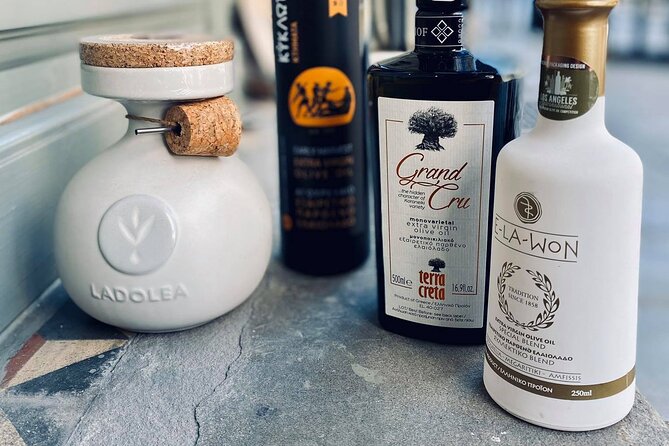
The meeting point is Olicatessen, at Ermou 24, inside Modiano Market. This puts the experience in the heart of Thessaloniki, rather than out in an olive-growing village or at a farm outside the city.
That location makes the tasting easy to add to a city day. You can arrive for the 10:00 am start, spend an hour with the oils, and continue exploring central Thessaloniki afterward. The activity ends back at the same meeting point, so there is no separate transfer to arrange.
The store itself is part of the experience. It is described as beautifully decorated, and the setting gives you a chance to see the products in a retail environment rather than in a plain classroom. That can be useful when you are deciding what to buy later. You can connect the tasting with the actual bottles and other Greek foods on display.
Modiano Market also gives the session a local food setting. You are not studying olive oil in isolation from Greek cooking. The market context reinforces the simple point that olive oil belongs at the center of everyday meals, not only in a formal tasting.
The market location does mean you should pay attention to the address and arrive with enough time to find the store. The meeting point is specific, and the session begins at 10:00 am. Since the activity lasts only about an hour, arriving late could cut into a large part of the tasting.
What happens during the one-hour session
The session begins with an introduction to Greek olive oil production. You learn about the country’s traditions, as well as newer methods and ideas shaping production today.
The emphasis is not only on history for its own sake. The useful question is how production choices affect what reaches your glass. Harvesting, processing, storage, olive variety, and growing region can all influence the finished oil. The guide connects those points to the samples in front of you, which makes the information easier to remember.
You then work through six oils. The exact order and presentation can vary, but the purpose is clear: taste each one with attention and compare it with the others. You are encouraged to notice the smell first, then the feel and flavor as you taste.
This is a good format for beginners because you do not need any previous olive oil experience. You can ask basic questions without feeling out of place. It also suits people who already buy premium oils and want a clearer sense of what they are paying for.
Guides associated with these sessions include Ellie, Alexandros, Kostas, and Teresa. The experience is personal rather than scripted in a large group. That matters because the best part of a tasting is often the follow-up question: Why does this oil feel peppery? What makes that one softer? How should I use this at home?
The private format means only your group participates. It does not guarantee that every session will take the same shape, but it does give you a more focused setting than a crowded public demonstration.
Learning to taste aroma, texture, and flavor
The most valuable lesson here is learning to slow down. Many people use olive oil as a background ingredient, pouring it over salad or cooking with it without paying much attention to its character. This session asks you to taste it on purpose.
Aroma is your first clue. You may notice fresh, green, herbal, fruity, or other scents. The guide helps you put words to what you detect, which is useful when you later compare bottles at home.
Texture gives another set of clues. Some oils feel light and clean, while others have more weight or a stronger sensation on the palate. Texture does not automatically make one oil better than another. It helps you decide which style you prefer and which foods might suit it.
Flavor is where the samples become most distinct. Some oils may be mild and easygoing. Others may have bitterness or a peppery quality. Those sensations can be surprising if you usually choose oil by price or packaging alone.
The point is not to turn you into a professional taster in 60 minutes. The point is to give you a working vocabulary and a better set of habits. After the session, you should be better prepared to smell an oil, taste it carefully, compare it with another, and decide how you want to use it.
Same groves, a different afternoon:
- From Chania: Olive Oil, Wine, Cheese & Honey Tasting Tour
★ 4.6 · 490 reviews - Crete: Road-trip to Lasithi, Zeus Cave & Olive Mill Farm
★ 4.4 · 451 reviews - Heraklion: Olive Farm Tour with Tasting of Local Delicacies
★ 4.9 · 411 reviews - Lassithi, Zeus Cave, Olive Mill Farm & Knossos Combo Tour
★ 4.6 · 404 reviews
Producer stories and the people behind the bottles
Olicatessen works directly with numerous producers. The tasting therefore includes more than sensory notes. You also hear about the people who grow, produce, and bottle the oils.
That producer focus adds value because olive oil is an agricultural product, not a factory-made flavor with no connection to place. The oil reflects choices made in the grove and during processing. Hearing those stories helps you understand why two Greek oils can taste so different even when both are high quality.
I also like that the store’s role is not limited to selling bottles. Its purpose is to showcase the producers and their products. You get a clearer idea of what you are buying and why a particular oil has been selected.
This is especially useful if you want to take Greek food products home. You can ask which oils are best for salads, cooking, dipping, or finishing a dish. The session includes guidance on pairing, so the lesson has a practical result rather than ending with the last sample.
The information provided does not specify the names of every producer or the exact regions represented in each session. You should expect variety across Greece, but not a fixed list of six bottles. That is worth remembering if you are hoping to taste oil from one particular island or district.
The final Greek food pairing
The tasting ends with something from traditional or modern Greek gastronomy chosen to complement the olive oils. This final food pairing gives the session a satisfying finish and shows how the oils work with food rather than only on their own.
It also helps you understand pairing in a simple way. A stronger oil may suit a hearty food, while a softer oil might work better with something delicate. The exact item is not specified, so you should treat it as a seasonal or changeable part of the experience rather than expect a named dish.
If you have dietary requirements, tell Olicatessen in advance. The activity information specifically asks participants to provide this information. That is particularly important when the final food item is selected to match the tasting.
The pairing is a small part of the hour, but it is one of the more useful details. You can taste an oil and admire it, but using it well at home is the real payoff. A simple food pairing turns the lesson into something you can repeat in your own kitchen.
Is $40.52 per person a fair price?
At $40.52 per person, this is not the cheapest way to sample olive oil in Thessaloniki. You could buy a bottle and taste it at home for less. The price makes more sense if you value the instruction, the six-oil comparison, the private format, and the chance to ask questions.
You are paying for a focused hour with a guide, not simply for six small portions. The session also includes producer background, tasting guidance, pairing advice, and a final Greek food item. For someone interested in food, Greek agriculture, or buying good olive oil, those extras make the cost easier to justify.
The value depends on your interest. If you only want a quick snack or a souvenir bottle, this may feel expensive. If you want to understand why oils taste different and choose more confidently in the future, it offers a useful introduction.
The short length helps and limits the experience. One hour is easy to fit into a busy Thessaloniki schedule. At the same time, it leaves little room for a long discussion about farming, storage, cooking, and regional production. Think of it as a sharp introduction, not a full-day food course.
Who should book this experience?
I would recommend it to anyone who enjoys Greek food and wants a clearer sense of what makes olive oil distinctive. It is also a strong choice for couples, small private groups, and curious cooks who want practical information they can use after returning home.
The activity suits beginners particularly well. You do not need to recognize olive varieties or know technical tasting terms before you arrive. The guide takes you through the process and gives you a way to compare the oils.
It also works for people who already know they like olive oil. The selection across regions and varieties gives experienced food lovers something to examine rather than offering only a basic product demonstration.
It may be less suitable if you dislike tasting sessions, have very limited time before another fixed appointment, or want an outdoor agricultural visit. You remain at the Olicatessen store in Modiano Market, and the focus is on tasting and explanation rather than visiting olive groves or an oil mill.
The private format is a strong point for anyone who prefers a calm, conversational activity. You can ask for clarification and discuss your own tastes without having to speak in front of a large public group.
Timing, access, and cancellation details
The experience starts at 10:00 am and lasts about one hour. It is near public transportation, and most people can participate. Service animals are allowed.
You receive confirmation at the time of booking, and the ticket is mobile, so you do not need a printed voucher. Since the activity takes place at a fixed store inside the market, check that you are heading to Ermou 24 rather than simply searching for Modiano Market in general.
The activity offers free cancellation up to 24 hours before the start time for a full refund. Cancellations or changes made less than 24 hours before the session are not accepted for a refund, and the cut-off follows local Thessaloniki time.
Should you book Olicatessen’s olive oil tasting?
Book it if you want to taste six Greek oils in a thoughtful setting and leave with a better understanding of how to judge them. The private format, central market location, producer stories, and final food pairing give the hour more substance than a simple shop sample.
I would especially choose it early in a Thessaloniki visit. The tasting can guide later food purchases, and you can return to the market with a better idea of what you like.
Skip it if your main goal is a cheap snack, a farm visit, or a long technical course. For food-minded visitors, though, the $40.52 price is reasonable when you treat the experience as both a tasting and a practical lesson in one of Greece’s key foods.
FAQ
Where does the olive oil tasting take place?
The tasting takes place at the Olicatessen store inside Modiano Market, at Ermou 24, Thessaloniki 546 24, Greece.
What time does the activity start?
The experience starts at 10:00 am.
How long does the tasting last?
The tasting lasts approximately one hour.
How many olive oils will I taste?
You will taste six olive oils from different Greek regions and olive varieties.
Is this a private activity?
Yes. Only your group participates in the activity.
Can I cancel for a full refund?
Yes. You can cancel at least 24 hours before the start time for a full refund. Cancellations and changes made less than 24 hours before the experience are not accepted for a refund.
Newest grove reviews around Greece
- Corinthian olive oil tour & tasting experience★ 5.0 · 4 reviews
- Corfu: Organic Olive Oil Farm Tour with Transfer and Tasting★ 5.0 · 8 reviews
- Corfu: Olive Oil & Wine Tastings & Traditional Villages Tour★ 5.0 · 6 reviews
- Chania: Authentic Crete Villages Tour & Olive Oil Tasting★ 4.5 · 2 reviews
- Chania Olive Tour: 3,000-Year-Old Tree, Museum &Organic Mill★ 5.0 · 5 reviews
- Chania Private Olive Oil Tour: Oil Tasting & Villages Tour★ 4.4 · 9 reviews
- Chania E-Bike Adventure: Culture, Coastline & Olive Tasting★ 5.0 · 2 reviews
- Athens: Cretan Olive Oil Tasting Experience★ 5.0 · 10 reviews
Greece Olive Oil Tours, compared.


Knossos-Zeus Cave -Old Traditional Villages-Olive Oil Factory
Read our review →
The Governor’s Olive Mill Tour with Olive Oil Tasting
Read our review →

Road-trip to Lasithi, Zeus Cave & Olive Mill Farm
Read our review →
Olive Farm Tour with Tasting of Local Delicacies
Read our review →
Lassithi, Zeus Cave, Olive Mill Farm & Knossos Combo Tour
Read our review →
Browse the lists this tour appears in