
Review · SPAIN OLIVE OIL TOURS
Johnny Madge Olive Oil Tastings
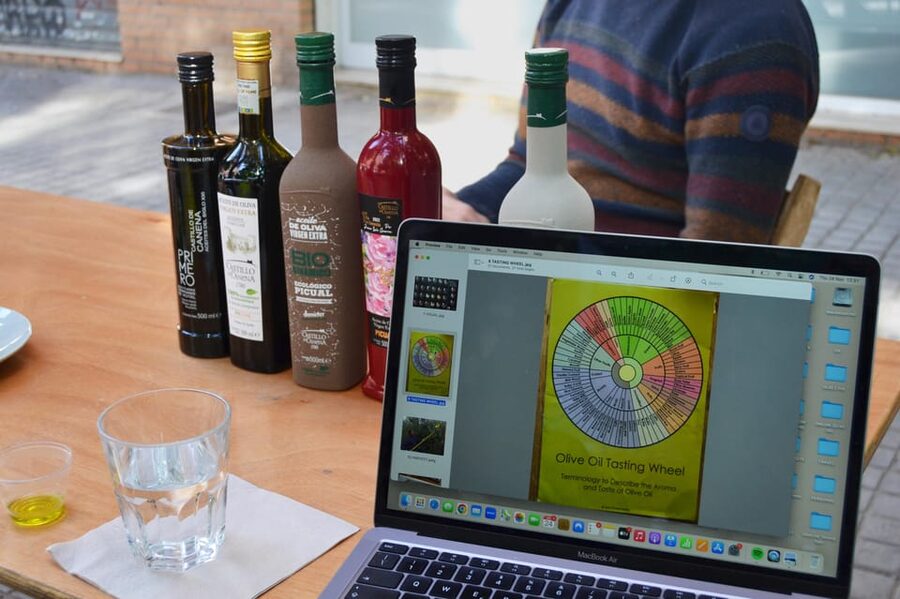
The most interesting part of this Valencia experience is that Johnny Madge tastes oils as an international competition judge, not as a producer trying to sell you one house brand. At La Ola Fresca in Benimaclet, you compare at least three carefully selected oils from Spain and other countries, using the same basic approach used in olive oil competitions.
I like the rare chance to smell oils in special biodegradable corn cups before tasting them. I also like the easy, personal teaching style: Johnny can explain oil-mill technology in detail, or keep things light if you simply want a tasty hour with bread and good conversation.
The main consideration is that this is a short class, not a full food tour or a visit to an olive farm. At $23 per person, it offers strong value for anyone curious about olive oil, but you should not expect a large meal or a long sightseeing program.
Key points for your Valencia food itinerary
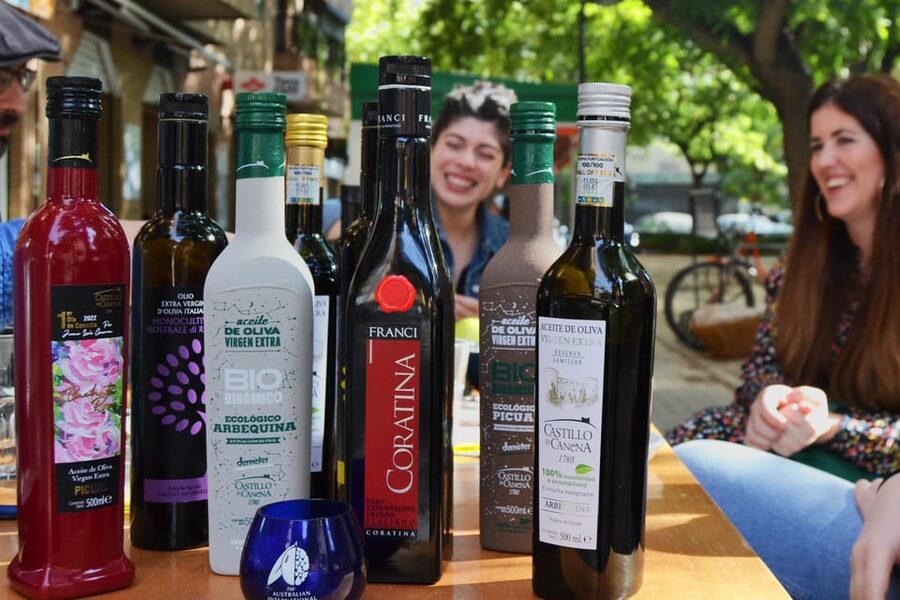
- Taste at least three top oils: The selection comes from an experienced international judge, with oils from Spain and other countries.
- Learn the competition method: You smell the oil first, then learn how judges assess it before tasting.
- Ask practical kitchen questions: Johnny covers cooking with olive oil, health, milling, food pairings, and storage-related basics as relevant to your questions.
- Choose your tasting style: You can taste the oil directly or use locally made sourdough bread, with gluten-free bread available.
- Meet at a relaxed local cafe: La Ola Fresca sits on a tree-filled square in Benimaclet, away from car traffic.
- Book a flexible one-hour activity: English, Italian, French, and Spanish are available, with free cancellation up to 24 hours ahead.
Why this is more than dipping bread in oil
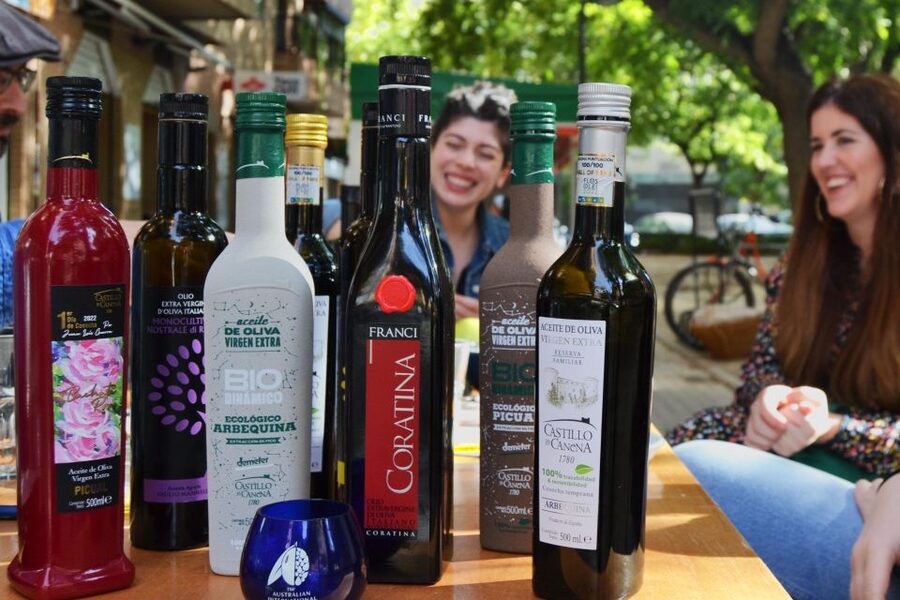
Many people know olive oil as a bottle on the kitchen counter. Fewer people know how wide its range can be. One oil may smell grassy and fresh, another may have peppery heat, and another may taste softer and rounder. This class gives you a way to notice those differences instead of treating all extra virgin olive oil as the same.
Johnny Madge has held tastings for 20 years and judges at international olive oil competitions. That background matters. You are not tasting only one producer’s work, and you are not being pushed toward a single commercial label. The oils are selected by someone whose job is to spot quality across many producers and regions.
The experience is also designed to be friendly rather than stiff. Johnny’s aim is to make you feel at ease, whether you want a basic introduction or every technical fact about how an oil mill works. You can ask a simple question about cooking, or get into the details of processing and defects.
A top rating of 4.9 from 10 verified bookings fits the experience’s strongest qualities: a warm host, clear explanations, excellent oils, and a format that feels personal. Adam and his partner praised Johnny’s welcome and passion. Callum called the hour one of his best experiences in Valencia. Donna appreciated that Johnny shaped the conversation around what she wanted to know.
More Olive Oil Tours around Spain:
- Ronda: LA Almazara LA Organic, Olive Oil Museum and Tasting
★ 4.6 · 435 reviews - Guided tour and olive oil tasting in Alhaurin el Grande (Málaga)
★ 5.0 · 200 reviews - Guided Tasting Tour in 16th century House and Olive Oil Factory
★ 5.0 · 169 reviews
Arriving at La Ola Fresca in Benimaclet
The meeting point is La Ola Fresca, a cafe in Benimaclet, one of Valencia’s city neighborhoods. Look for the large sign outside. The cafe is on a square full of trees rather than beside a road used by cars, which gives the setting a calmer feel than a busy central street.
This location is useful if you want to add a local neighborhood stop to your Valencia plans. It is not presented as an olive farm, mill, or museum. The focus begins inside the cafe with the tasting itself. You get a comfortable place to sit, talk, and compare oils without spending hours traveling outside the city.
Because the activity lasts one hour, it can fit neatly into a morning or afternoon. You can book it as a food-focused break between Valencia sightseeing stops, or make it part of a day spent exploring Benimaclet. Drinks such as coffee and tea are not included, though water is provided free.
The cafe setting also helps set expectations. This is a hosted tasting in an urban space, not a formal culinary school session. That works well for couples, solo visitors, and small groups who want a direct introduction without a full-day commitment.
The first step: smelling the oil
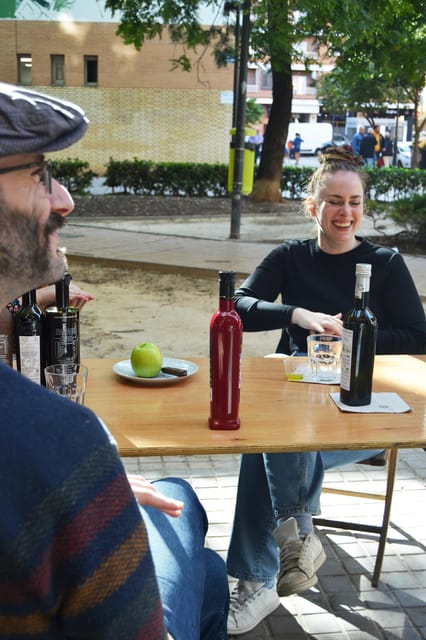
Johnny begins by explaining how judges assess olive oil in international competitions. The first stage is smell. You use special olive oil cups made from biodegradable corn, rather than ordinary glasses or tasting dishes.
Smelling comes before tasting for a reason. The aroma can tell you a lot about an oil’s character and condition. Johnny guides you through the scents in the selected oils, allowing you to notice how different they can be. You do not need a trained palate. The point is to give you a method and help you trust what you are sensing.
This part is especially useful if you usually pour oil straight onto food. Bread, salad, or cooking can hide much of an oil’s individual character. By trying the oil on its own, you get a clearer idea of its aroma and flavor before discussing how it works with food.
At least three oils are included. The selection may include oils from Spain as well as other countries, so the comparison is not limited to one local style. Spain is a major olive oil country, but the wider selection helps show that quality and flavor are not confined to one region.
Tasting the oil, with or without bread
After smelling the oils, Johnny explains how to taste them. If you want to follow the competition approach, you can taste the oil directly. If that feels too intense or unfamiliar, you can use bread instead.
Locally made sourdough is normally available, and gluten-free bread can be provided. This is a small but useful detail. Bread gives the tasting a more familiar shape, while direct tasting gives you a clearer sense of the oil’s texture and flavor.
You are not required to perform like a judge. Johnny’s teaching style allows you to choose how seriously you want to take the process. You might focus on the pleasant flavors and learn a few useful terms, or ask for the full technical explanation of how professionals assess oil.
That flexibility is one of the activity’s best features. Someone who already cooks with olive oil can ask detailed questions, while someone who has never attended a tasting can simply follow along. Donna specifically valued the way Johnny adjusted the session to the subjects she wanted to understand.
Same groves, a different afternoon:
- Visit of the olive grove, olive oil tasting and snack
★ 4.9 · 111 reviews - Visit Oil Mill Museum and Olive Oil Tasting in Ronda
★ 4.5 · 105 reviews - Private Tasting of Olive Oil in Córdoba
★ 5.0 · 93 reviews - Olive Oil tasting breakfast & Tour in Cordoba
★ 4.5 · 84 reviews
What extra virgin really means
The class tackles a phrase that appears on countless bottles: extra virgin olive oil. Johnny explains what the term means and how an oil qualifies as extra virgin.
This is practical information because labels can make olive oil seem more confusing than it needs to be. The word extra virgin is not just a decorative marketing phrase. It relates to the quality and characteristics of the oil, and Johnny can explain the standards in plain language.
He also discusses first cold pressed, a phrase that often appears to promise superior quality. The wording can be confusing, especially when shoppers assume it automatically means the best oil available. Johnny explains why that expression does not tell the whole story.
You leave with a better set of questions to ask when buying oil. Instead of choosing a bottle only because of attractive packaging or a familiar phrase, you can pay attention to what the label does and does not tell you. That alone may make the $23 fee worthwhile for regular home cooks.
How the best oils are made, and how bad oils happen
Johnny can explain how olive oil mills work and use photographs to make the process easier to understand. If you enjoy technical detail, you can ask about milling technology and the steps that affect final quality.
The class also covers how the best oils are made and how poor oils can result. That comparison matters. It connects the flavor in your cup with the choices made before the oil reaches a shop shelf.
You should not expect a full mill tour, since the tasting takes place at the cafe. Instead, you get an expert explanation supported by photographs and conversation. For a one-hour city activity, that is a sensible trade-off. You spend the time tasting and asking questions rather than traveling to a distant production site.
Johnny’s competition work gives this section a useful angle. He knows how oils are judged across different producers, not only how one company describes its own product. That helps keep the discussion focused on what is actually in the cup.
Cooking, health, and pairing questions
Bring your olive oil questions. Johnny can discuss health, using oil with food, milling, and the common question of whether you can cook with olive oil. The answer is yes, and the session gives you a chance to ask about practical use rather than simply tasting for its own sake.
You can also ask how to match oils with food. The tasting lets you first notice the oils alone, then think about where their flavors might work best. Bread is included as an option, but the discussion can extend to broader food use.
This is where the class becomes more useful than a simple sample table. You are not only deciding which oil tastes nicest. You are learning how to judge an oil and think about how it fits your own cooking.
Still, the hour has limits. Johnny can answer many questions, but the activity is not advertised as a full cooking lesson or meal. Drinks beyond free water cost extra, and there is no promise of a larger food spread.
A friendly teaching style for beginners and oil enthusiasts
Johnny’s style is built around making people comfortable. He has been holding tastings for two decades, so he knows that some people arrive eager to discuss extraction methods while others worry they will not taste the right things.
You can keep the session relaxed, funny, and straightforward. If you want the nerdy details, Johnny can explain how oil mills operate and show photographs. If you prefer an informal introduction, he can keep the focus on the oils, the flavors, and ways to use them.
The language choice helps too. The experience is offered in English, Italian, French, and Spanish. That makes it easier to ask precise questions about food and production, especially if you are more comfortable speaking about those subjects in your strongest language.
The personal tone is a major part of the value. The goal is to feel more like an invited participant than someone being rushed through a sales pitch. That distinction matters because the oils are selected from across producers and countries, rather than being presented as one producer’s own collection.
Is $23 a fair price?
At $23 per person, this is reasonably priced for a one-hour specialist tasting in Valencia. You receive at least three high-quality oils, instruction in the method used at international competitions, bread if you want it, and time to ask questions directly to an international judge.
The value is strongest if you are interested in food, cooking, Spanish produce, or taking home better shopping habits. A person who simply wants a free sample may find the price less appealing, but that misses the teaching element.
You are paying for selection as well as quantity. The oils are chosen by someone with 20 years of tasting experience and judging work, so the point is not to pour several ordinary oils and let you guess which one is best.
The price does not include coffee, tea, or other drinks. Water is free. Keep that in mind if you plan to linger at the cafe after the hour.
Who should book this tasting?
I would recommend it to curious cooks, food-focused visitors, couples, solo visitors, and anyone who has ever wondered why one bottle of olive oil costs more than another. It also suits people who want a short activity that feels local and conversational rather than a large organized tour.
It is a good choice for beginners because you can use bread and ask basic questions without needing prior experience. It also works for serious olive oil fans because Johnny can discuss milling, competition methods, and technical details.
Families and groups should note the one-hour format and the tasting focus. The experience is centered on smell, taste, and conversation, so it is best for people who are interested in those things. It is not a sightseeing tour with several stops.
The activity is wheelchair accessible. You can cancel up to 24 hours before the start for a full refund, and the reserve-now, pay-later option keeps the booking flexible.
Should you book Johnny Madge’s olive oil tasting?
Book it if you want to understand what makes extra virgin olive oil different, not just sample another dip for bread. The strongest reasons are Johnny’s 20 years of tasting experience, his work as an international competition judge, and the chance to compare oils chosen from Spain and beyond.
You should also book if you value practical advice. The session covers labels, cooking, food use, milling, and the difference between good and poor oil. That information can stay useful long after your Valencia visit.
Skip it if you want a full meal, a farm visit, or a long tour outside the city. But for $23, one hour, and at least three carefully chosen oils in a friendly Benimaclet cafe, this is a smart pick for food lovers. Just be warned: after learning how good olive oil can taste, your cheapest bottle may never seem quite the same again.
FAQ
Where does the olive oil tasting take place?
The tasting takes place at La Ola Fresca cafe in Benimaclet, Valencia. The cafe has a large, visible sign and sits on a tree-filled square away from a road used by cars.
How long does the experience last?
The tasting lasts one hour. Starting times vary, so you should check availability when booking.
How much does the tasting cost?
The listed price is $23 per person.
How many olive oils will I taste?
The experience includes a tasting of at least three of the world’s best olive oils.
Is bread provided?
Bread is available for those who prefer not to taste the oil directly. The usual option is locally made sourdough, and gluten-free bread is available as well.
Are drinks included?
Water is provided free. Coffee, tea, and other drinks are not included.
Which languages are available?
The live guide is available in English, Italian, French, and Spanish.
Is the activity wheelchair accessible?
Yes, the experience is wheelchair accessible.
Can I cancel my booking?
Yes. You can cancel up to 24 hours in advance for a full refund. A reserve-now, pay-later option is also available.
Newest grove reviews around Spain
- XXI Century Olive Oil Mill Tour★ 5.0 · 3 reviews
- Visit to an olive oil mill and oil tasting with aperitif and food and wine pairing.★ 5.0 · 2 reviews
- Treurer: Tapas Gourmet and Extra Virgin Olive Oil★ 4.7 · 3 reviews
- Olive Oil and Winery Tour from Zaragoza City★ 5.0 · 4 reviews
- Ulldecona: Guided Tour of the Millenary Olive Trees of Arión★ 5.0 · 2 reviews
- Olive Oil Private Full-Day Tour with Tasting in Valencia★ 5.0 · 2 reviews
- Olive Oil Factory from Seville Private Tour★ 5.0 · 2 reviews
- Olive Oil Tasting Experience in Sevilla★ 5.0 · 2 reviews
Spain Olive Oil Tours, compared.
LA Almazara LA Organic, Olive Oil Museum and Tasting
Read our review →
Guided tour and olive oil tasting in Alhaurin el Grande (Málaga)
Read our review →
Guided Tasting Tour in 16th century House and Olive Oil Factory
Read our review →
Visit of the olive grove, olive oil tasting and snack
Read our review →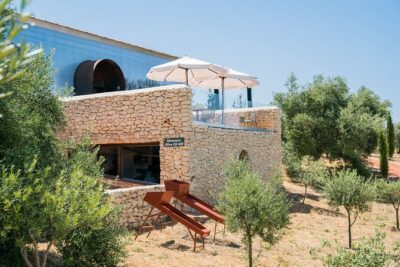
Visit Oil Mill Museum and Olive Oil Tasting in Ronda
Read our review →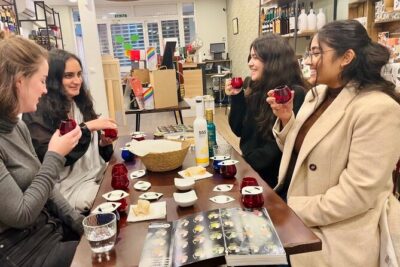
Sóller: Olive Oil Guided Tour and Tasting at Can Det Estate
Read our review →Browse the lists this tour appears in