
Review · RAKI AND OLIVE OIL TASTINGS
Tirana Walking Tour, Extra Virgin Olive Oil and Raki Tasting
Tirana’s story makes the most sense on foot, and this tour adds a tasty Albanian finish: extra virgin olive oil and fruit raki tasting, with stops at the city’s major landmarks. Guide Taulant has been especially praised for explaining the past in plain language and offering useful tips for shops and restaurants.
I like the mix of old Ottoman-era sights and modern Tirana, especially the contrast between the former communist district of Blloku and the newly renewed Pyramid. I also like the modest $22.69 price for a two- to three-hour private walk. The main concern is the operator’s record of one serious scheduling mistake, so confirm your meeting details before setting out.
Key points at a glance
- Taste more than standard Albanian snacks: Try extra virgin olive oils and several fruit-based rakis, including blackberry and plum varieties.
- See Tirana’s main landmarks in one walk: The route includes Skanderbeg Square, the Clock Tower, Tirana Castle, Blloku, and the Pyramid.
- Get local context from Taulant or another certified guide: The strongest praise centers on clear history, personal insight, and practical suggestions for the rest of your stay.
- Expect a flexible private-group format: The experience is offered for your own group, though the stated maximum is 30 people.
- Plan for an easy central meeting point: Start by the equestrian statue of Skanderbeg and finish back there.
- Watch the clock and the weather: Cancel at least 24 hours ahead for a full refund, and poor weather may lead to a new date or refund.
Why this walk works well in Tirana
Tirana can feel confusing at first. Its central square, broad boulevards, Ottoman remnants, communist monuments, and polished cafés belong to very different chapters of the city’s story. A guide helps connect those pieces instead of leaving you with a string of attractive buildings and disconnected dates.
This experience stays in central Tirana, so you spend your time walking rather than sitting in a vehicle. That matters here. The changes in architecture and public space are part of the story, and you see them best from the pavement.
The tour lasts about two to three hours. That is enough time to get your bearings, hear the main historical outline, and sample local products without giving up an entire day. I would book it early in a Tirana visit, then use Taulant’s suggestions for the rest of your stay if he is your guide.
The tasting is more than a quick drink at the end. You try different extra virgin olive oils and several rakis distilled from fruit such as blackberries and plums. It gives you a small but useful introduction to Albanian food culture, with enough variety to compare flavors rather than simply accept one sample.
More Raki and Olive Oil Tastings around the world:
- Crete: Full-Day Cretan Wines, Olive Oil, Raki and Food Tour
★ 5.0 · 264 reviews - Crete: Olive Oil, Soap, Wine, Raki – Flavorful Culinary Journey
★ 5.0 · 119 reviews - Crete: Olive, Wine, & Raki on a Flavorful Culinary Journey
★ 4.7 · 56 reviews
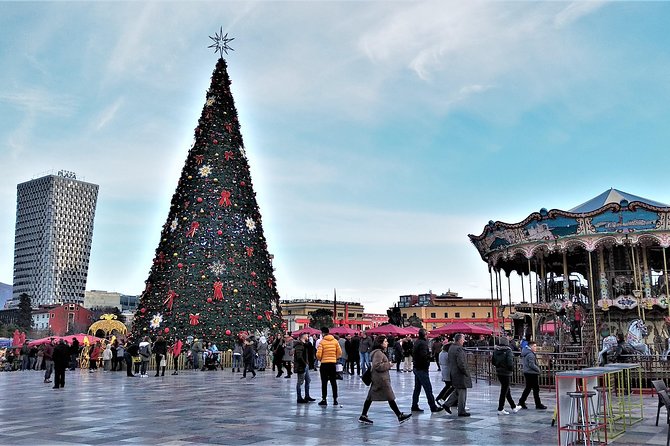
Starting at Skanderbeg Square
The meeting point is the equestrian statue of Skanderbeg in Skanderbeg Square. This is a practical place to begin because the square is one of Tirana’s clearest reference points, and the statue is easy to identify.
The square has changed purpose and appearance many times. It was conceived before the Second World War by Italian architect Armando Brasini. Over the years, it hosted statues connected with Stalin, Skanderbeg, and communist leader Enver Hoxha. Today, only the Skanderbeg statue remains among those major political symbols.
Your guide explains how the square reached its present form after those shifts. That background helps you read Tirana’s public spaces as political documents. A large central square is never just a place to cross. In this case, it reflects monarchy, Italian planning, communism, and post-communist Albania.
You spend about 20 minutes here. That is long enough for an overview and some orientation, but not so long that the tour becomes a lecture in one spot. Keep your attention on the guide’s explanation of the changes, since the visual setting alone does not tell the full story.
The Clock Tower and the Ottoman chapter
The Tirana Clock Tower dates from 1822 and is one of the oldest structures built in the city during the late Ottoman period. It gives the tour an important change of pace after the grand scale of Skanderbeg Square.
The tower is a reminder that Tirana existed long before the Italian-designed boulevards and communist monuments that often dominate first impressions. Its date places it in a different urban chapter, when the city’s identity was tied to the Ottoman world.
The supplied schedule does not list a separate admission or interior visit, so you should treat this as a guided exterior stop rather than expect a climb or museum visit. That is not a serious drawback on a short walking route, but it is useful to know if you are hoping to go inside.
Murat Toptani Street links the city’s layers
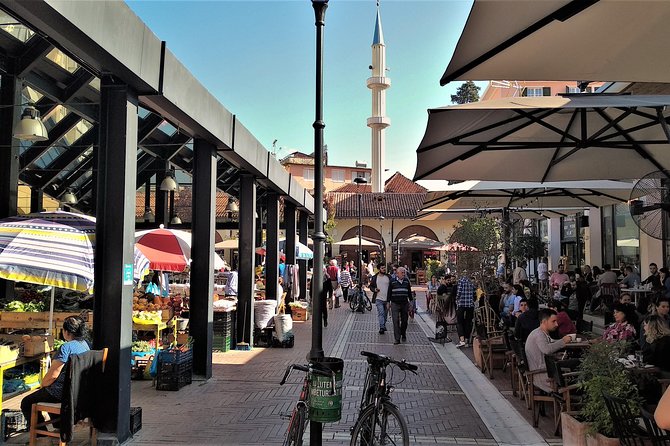
The pedestrian Murat Toptani route is one of the most useful parts of the walk. It connects several landmarks and gives you a continuous path through central Tirana rather than a series of isolated stops.
Along or near this route, you can encounter Tirana Castle, the Academy of Sciences, the old National Library, the former Political Persecutor’s Building, and Tanners Bridge. The area also includes the National Gallery of Arts and the residence of the Albanian royal family.
That mixture is what makes the walk worthwhile. You are not seeing only the polished, newer side of the city. You are also passing places tied to education, monarchy, political persecution, religion, and cultural life.
The route is pedestrian, which keeps the pace relaxed. One useful detail from the experience is the guide’s care in seeking shade when possible. That can make a real difference in warmer weather, especially because the walk lasts several hours and Tirana’s open central spaces can feel exposed.
More Olive Oil Tours around the world:
- Sorrento Farm and Food Experience including Olive Oil, Limoncello, Wine tasting
★ 5.0 · 2,524 reviews - Split: Krka Waterfalls With Boat Cruise, Wine and Olive Oil
★ 4.3 · 1,507 reviews - Crete: Quad Safari, Olive Mill with Tasting & Ghost Village
★ 4.9 · 1,004 reviews - From Mendoza: 3 Wineries, Olive Oil Factory Tour & Tasting
★ 4.6 · 901 reviews
Tirana Castle and the tasting
Tirana Castle, or Kalaja e Tiranës, is a modern tourist area on Toptani Pedestrian Street. Its setting combines historic reference with newer restaurants and commercial spaces, making it a natural place for the food and drink portion of the experience.
The castle stop itself lasts about 15 minutes and has no admission charge. Do not expect a preserved medieval fortress on the scale of a major European castle. The appeal is the way the site has been brought into the current city, with the name and setting connecting contemporary Tirana to earlier periods.
The olive oil and raki tasting is the tour’s most distinctive feature. Extra virgin olive oil is central to Albanian cooking, and tasting several examples lets you notice differences in flavor and texture. The raki selection adds another part of local food culture, with fruit-based versions made from blackberries, plums, and other produce.
Go slowly with the raki. The samples are small, but distilled spirits can catch you by surprise, especially if you have already spent time walking. Snacks, meals, and other drinks are not included, so do not treat the tasting as lunch.
The tasting has particular value if you are curious about what to buy later. You can ask the guide which products are typical and where to look for local food during the rest of your stay. The experience does not promise a shopping stop, so use the conversation for advice rather than expecting a market visit.
Blloku shows Tirana after communism
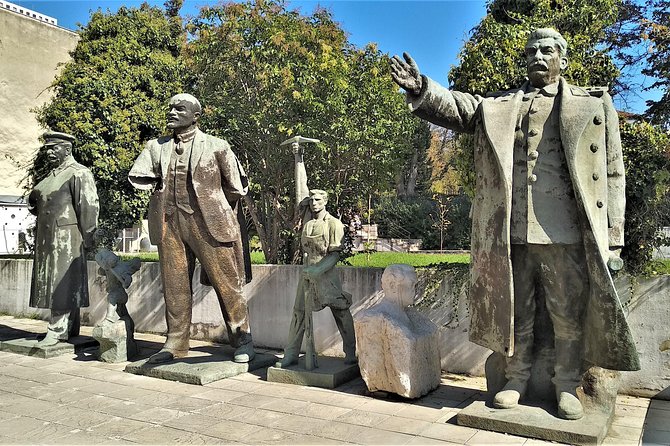
Blloku, also called Ish-Blloku, offers one of the sharpest contrasts on the route. Today it is an upscale district with boutiques, restaurants, cafés, pubs, and bars. During the communist period, it was a restricted residential area for members of the political leadership, and ordinary Albanians could not enter.
That change gives Blloku more meaning than its current nightlife suggests. It became a popular entertainment area after the fall of communism, and the district now represents the freedom and consumer culture of the newer Tirana.
You can still find the former residence of Enver Hoxha here. Its presence makes the area’s transformation easier to understand. A café-lined street may look carefree today, but it occupies a place that once belonged to Albania’s closed political elite.
The stop lasts about 15 minutes. That is enough for context and a look around, but not enough for a full meal or extended café time. If Blloku interests you, return later on your own. The tour gives you the background; it does not replace an evening spent exploring the district.
The Pyramid turns a difficult past into a public place
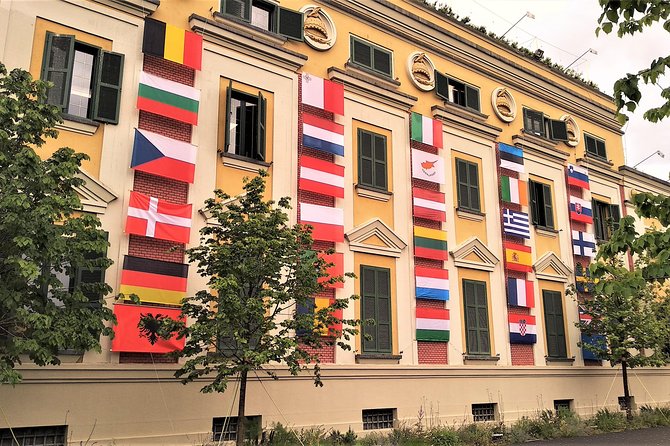
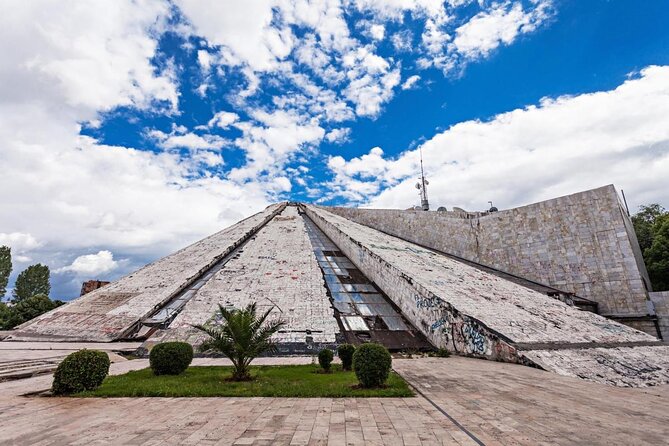
The Pyramid of Tirana was inaugurated in 1988 as the Enver Hoxha Museum. It served as a heritage museum for the communist leader until 1991. Its shape refers to an Egyptian pyramid, while its overhead design reveals a communist star spreading its rays.
The building has since been renewed, giving it a different role in present-day Tirana. Its unusual form makes it one of the city’s most memorable structures, but its meaning comes from the political story attached to it.
This is a worthwhile stop because it does not present the past as something tidy. The Pyramid has changed from a monument to a communist leader into a public building with a newer purpose. Your guide can help explain that shift and place it beside the other changes you have seen at the square, in Blloku, and along the central streets.
The stop lasts about 15 minutes and does not include an admission charge. The information provided does not promise entry inside, so expect to view and discuss the building rather than book the tour for an interior visit.
Brasini, Bosio, and the Italian mark on Tirana
The walk also covers the grand boulevard shaped by Italian architects Armando Brasini and Gherardio Bosio. Brasini gave the boulevard a European Renaissance style, while Bosio later developed its neoclassical character and practical civic buildings.
The project drew interest from Mussolini, who met with both architects to hear about its progress. That detail adds political weight to the architecture. The buildings are not simply decorative examples of European design. They also reflect Italian involvement in Albania and the complicated politics of the period.
This is one place where a local guide adds real value. A guidebook can name an architect and give a date, but an in-person explanation can show you how the buildings fit into Albania’s wider political story. Taulant has been praised for making this kind of history engaging and for adding personal insight beyond standard facts.
What the guide adds to the route
The strongest part of this experience depends on the guide. Taulant is specifically noted for explaining Albanian history with energy and for giving practical recommendations for shops and restaurants. He also shared suggestions for places to see after the walk, which makes the tour more useful than a fixed list of landmarks.
The format is described as private for your group, allowing you to move at your own pace. At the same time, the published maximum is 30 people, so confirm the exact arrangement if group size matters to you. A small private group should feel more conversational, while a larger group may make it harder to ask questions during busy street sections.
English is the offered language. The guide is professionally certified, and most people can participate. The route begins and ends at the Skanderbeg statue and is near public transportation, so it is simple to fit around other central Tirana plans.
One practical warning deserves attention. A past booking-date error left a customer waiting 45 minutes without a guide or response. The operator later apologized, issued a full refund, and offered a free replacement tour, but the incident still matters when you plan a short holiday. Save the meeting details, confirm the date, and keep the operator’s contact information handy.
Is $22.69 good value?
At $22.69 per person, I consider this a good-value introduction to Tirana if you want both sightseeing and food sampling. You get roughly two to three hours with a certified guide, several central landmarks, and a tasting that is more distinctive than a generic city walk.
The price is especially reasonable for a private-group format, though the group-size wording should be clarified at booking. It is less compelling if you want extensive interior visits, a full meal, or a long stop at every attraction. Admission tickets are free at the listed stops, and meals, snacks, and drinks beyond the included tasting are not covered.
Think of the price as paying for orientation, explanation, and a local tasting, not for a full-day cultural program. That is a fair trade for a first morning or afternoon in Tirana.
Who should book this walk?
I would choose it for a first visit to Tirana, especially if you want the main central sights without spending a full day on a formal museum schedule. It suits people who like walking, asking questions, and learning how a city changed from Ottoman rule through Italian planning and communism to its current social life.
It is also a good fit if you want an introduction to Albanian olive oil and raki before buying food products elsewhere. Families and mixed-age groups may appreciate the short stops and central route, though anyone sensitive to heat should ask the guide to keep using shaded streets when possible.
You may want a different activity if your priority is a deep museum visit, a long food tour, or countryside scenery. This is a compact city orientation with a tasting, not a complete survey of Albania.
Should you book the Tirana Walking Tour?
Book it if you want a reasonably priced first look at Tirana, a guide who can explain difficult historical changes, and a tasting of olive oils and fruit rakis. The combination of Skanderbeg Square, Blloku, the Pyramid, and Tirana Castle gives you a useful map of the city’s past and present.
I would confirm the meeting date and group format before paying, then arrive ready to walk for up to three hours. If those details suit your plans, the tour offers a lot for $22.69 and gives you practical ideas for what to see and eat next.
FAQ
Where does the tour start?
It starts at the equestrian statue of Skanderbeg at Skanderbeg Square, Tirana, Albania.
Where does the tour end?
The activity ends back at the meeting point.
How long does the walking tour last?
It lasts approximately two to three hours.
What language is offered?
The tour is offered in English.
What food and drink are included?
The experience includes extra virgin olive oil and different rakis distilled from fruit such as blackberries and plums.
Are meals and snacks included?
No. Meals, snacks, and drinks other than the included tasting are excluded.
Is Tirana Castle free to enter on this tour?
The Tirana Castle stop has no admission ticket charge listed.
How many people can join?
The stated maximum is 30 people. The experience is also described as private for your group, so confirm the group arrangement when booking.
Is the tour near public transportation?
Yes. The meeting area is near public transportation.
Can I cancel for a full refund?
Yes, if you cancel at least 24 hours before the experience start time. Changes or cancellations made less than 24 hours ahead are not accepted for a refund. If poor weather causes cancellation, you are offered another date or a full refund.
Newest grove reviews around the world
- XXI Century Olive Oil Mill Tour★ 5.0 · 3 reviews
- Zadar, Šibenik: olive oil, wine & food tasting, Self Drive★ 4.7 · 9 reviews
- Visit to an olive oil mill and oil tasting with aperitif and food and wine pairing.★ 5.0 · 2 reviews
- Villa Castelli: Highlights Walking Tour w/ Olive Oil Tasting★ 4.8 · 12 reviews
- Athens: Greek Wine & Olive Oil Tasting at Brettos Plaka★ 4.5 · 3 reviews
- Vernazza (5 Terre): olive grove tour and oil and wine tasting★ 5.0 · 9 reviews
- Treurer: Tapas Gourmet and Extra Virgin Olive Oil★ 4.7 · 3 reviews
- Unveiled Secrets of Porto + Olive Oil Tasting★ 4.8 · 3 reviews
Raki and Olive Oil Tastings, compared.
Full-Day Cretan Wines, Olive Oil, Raki and Food Tour
Read our review →
Olive Oil, Soap, Wine, Raki – Flavorful Culinary Journey
Read our review →
Olive, Wine, & Raki on a Flavorful Culinary Journey
Read our review →
Premium Crete Olive oil tasting, Wine, Raki and Cretan food!
Read our review →
Premium Cretan Olive Oil Tasting, Wine, Raki and Local Food Tour
Read our review →
Small Group: Knossos, Olive Oil, Winery & Raki with Lunch
Read our review →
Soap, Wine, Raki, Olive Oil, Meet the local Producers Tour
Read our review →Browse the lists this tour appears in